
By Mike Tenbusch | March 11, 2021
There was a fascinating article by Siddhartha Mukherjee in the New Yorker last week about the wide divergence in how the pandemic has affected different nations. Some nations are continuing to show inexplicable resilience to the virus compared to other nations. The number of COVID deaths per capita in Nigeria, for example, is a hundredth of the death rate suffered in the US. This is a trend that has held up in much of sub Saharan Africa and South Asia compared to wealthier, more industrialized nations like Belgium, Italy, Spain, the United Kingdom and the United States, which have some of the highest COVID death rates in the world.
So what gives?
Dr. Mukherjee examines a variety of possible reasons, including:
- Under-reporting of deaths stemming from COVID.
- Proactive responses taken by different governments.
- The median age of the population (which is 28 in India and 47 in Italy, for example).
- Differing living arrangements for the elderly in senior communities versus at home with younger generations.
- Stronger immune system responses acquired by variations of viruses in the past.
- Lower viral lodes in warmer climates due to less indoor gatherings.
Ultimately, he concludes that the answer is no single one of these factors, but is likely a combination of all of them.
That’s not to say that these nations have emerged unscathed from the virus. Economies have stalled, people have missed critical medical visits, and kids have missed wide swaths of schooling — causing immediate and long-term problems, particularly for the most vulnerable.
It’s also not to say that any one of these nations has made it safely to the other side. A new wave of COVID, or its more dangerous variants, could still ravage a nation, especially considering the long lag time before vaccinations will be widely available in developing countries.
Regardless of what may come, we will continue to walk hand-in-hand with almost 1,000 families whose struggle to survive preceded the pandemic. They will have food to eat, tuition bills paid for their children, and tablets to succeed in school because of Samaritans like you who have heard and answered the call of Jesus to go and do likewise.
If you take a moment today to reflect on how your life and our world is different because of the events over the last twelve months, know that it is a much better world in powerful ways because of people like you.
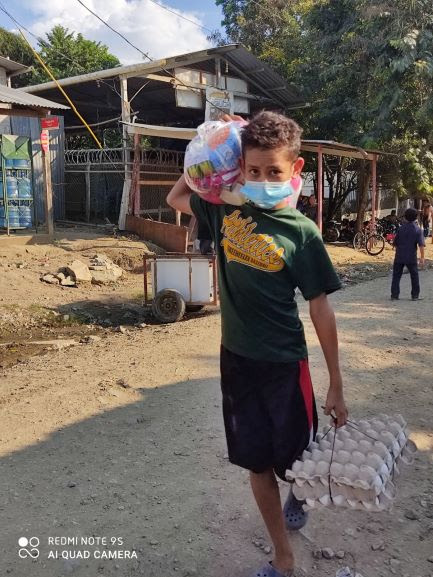
One of our scholars in Honduras taking his March food basket back to his family. These food baskets started being distributed almost exactly a year ago and have been delivered every month since then, allowing our scholars and their families to remain fed while sheltering in place.
What’s Most Important in Your Community?
On Mother’s Day in Guatemala, 70 women from a village bordering a dumpsite on the outskirts of Guatemala City gathered to work with our team on the answer to that question. Figuring out a list of needs was the easy part. They need: A school A recreation center Access...
Where do you see God in Life?
What I love about our work at International Samaritan is how often I see and feel the presence of God in what we do. Recently, I had the unique privilege of sitting in on the conversations that our scholarship students in Guatemala were having with a woman who has...
Come Find Out if Trump was Right
In retaliation for what he perceives to be a lack of support from the leaders of Central American nations, President Trump announced last week that he intends to cut $500 million from programs addressing the root causes of migration from those nations. This makes me...
